If you already have someone handling IT in-house, but they’re stretched too thin to cover nights, weekends, and every security tool your business needs, you don’t have to choose between doing nothing and hiring a second full-time employee. That’s exactly the gap co-managed IT is built for.
What Co-Managed IT Actually Means
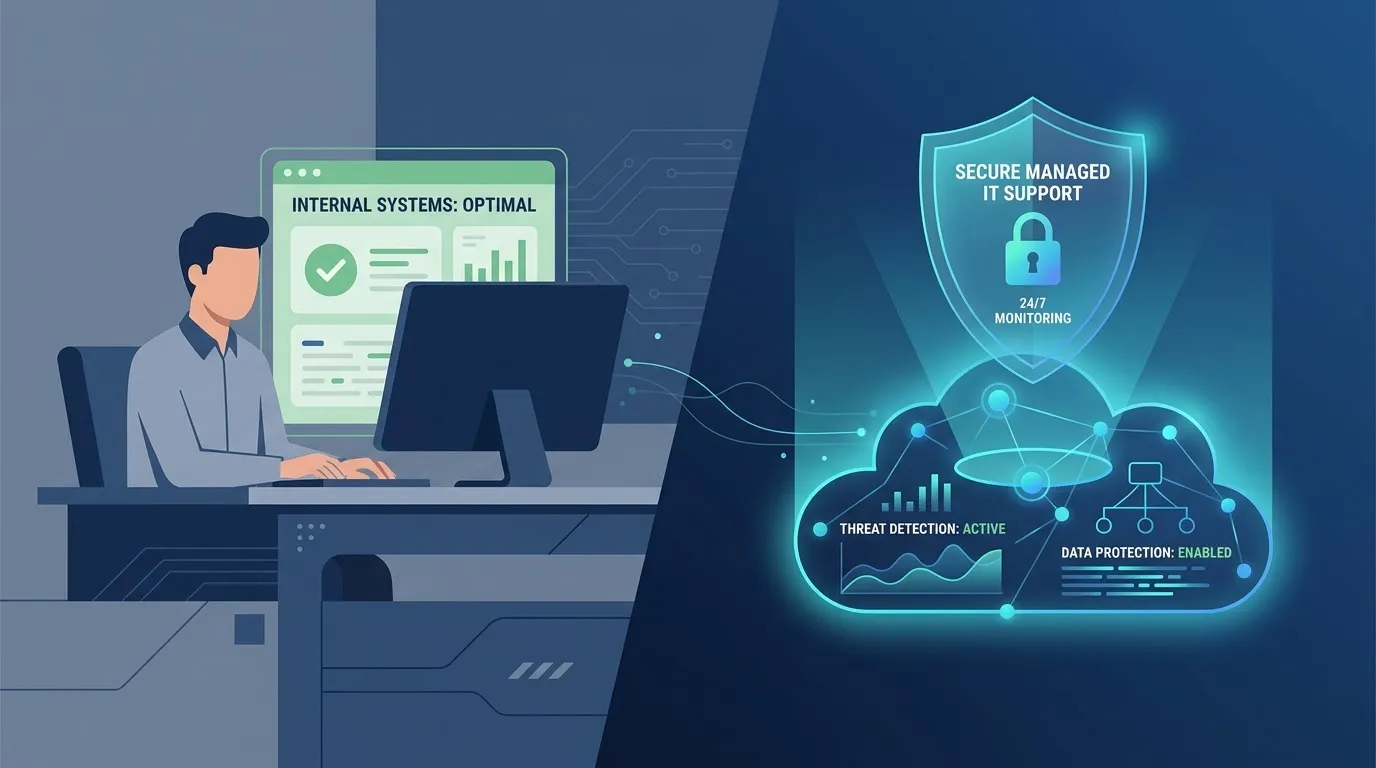
Co-managed IT is a partnership model, not a replacement. Your internal IT person or team keeps their role and their relationships with your staff. An outside provider works alongside them, typically covering:
- 24/7 network monitoring — so problems get caught overnight and on weekends, not just during business hours
- Helpdesk overflow — extra hands during busy stretches, vacations, or when ticket volume spikes
- Cybersecurity tooling — endpoint detection and response, threat monitoring, and email security that would otherwise require a dedicated specialist to run well
- After-hours and emergency support — coverage for the 2 a.m. server alert your one IT employee shouldn’t have to be the only person awake for
- A second opinion — an outside team to bounce decisions off of on bigger projects like a cloud migration or a security overhaul
Nothing about co-managed IT assumes your internal person isn’t doing a good job. It assumes one person, or even a small internal team, can’t realistically be everywhere at once.
Co-Managed vs. Fully Managed: What’s the Real Difference?
| Fully Managed IT | Co-Managed IT | |
|---|---|---|
| Internal IT staff | Typically none | Yes, an existing person or team |
| Provider’s role | Owns the entire IT function | Fills specific gaps around your team |
| Best fit | Businesses with no in-house IT | Businesses with an internal person who needs backup |
| Day-to-day relationship with staff | Provider | Stays with your internal team |
If you’ve read up on what a managed service provider does and thought “that’s basically what my IT person already handles,” co-managed IT is likely the better fit than switching to a fully outsourced model.
Why Co-Managed IT Beats Hiring a Second IT Employee (Usually)
A second full-time IT hire costs a salary, benefits, training time, and still leaves you covered by exactly one more set of business hours. Co-managed IT is usually the better trade for a few reasons:
- You’re paying for coverage hours, not a person’s calendar — nights, weekends, and PTO are covered without needing a body in a chair
- You get specialists, not generalists — cybersecurity threat monitoring, cloud administration, and network engineering are each their own discipline; one internal hire is unlikely to be deeply skilled in all of them
- It scales with you — add or remove coverage as your business grows, without a hiring or layoff decision attached to it
- Your internal person gets to specialize too — instead of being pulled in ten directions, they can focus on the parts of the job that actually require knowing your business
Signs Your Business Is a Good Fit for Co-Managed IT
- Your IT person is the only line of defense outside business hours
- You’ve had a security incident (or a close call) that exposed a gap in tooling or monitoring
- Ticket backlogs pile up whenever your IT person is out sick or on vacation
- You’re growing fast enough that one person can no longer keep up with both daily support and strategic projects
- You want better cybersecurity coverage but can’t justify a full-time security hire
How CelereTech Fits In
CelereTech provides co-managed IT services for small and mid-sized businesses across Chicago and Northern Illinois, working directly alongside your existing internal IT staff rather than replacing them. We handle the after-hours monitoring, cybersecurity stack, and overflow support your team needs, so your internal person can stop being the only line of defense.
Curious what a co-managed setup would look like for your team? Schedule a free consultation and we’ll map out exactly where the gaps are.