Think your small business is flying under the cybercriminal radar? 43% of cyberattacks target small and medium-sized businesses, yet only 14% of these companies feel prepared to defend themselves. Ransomware attacks have increased by over 41% in the past year, and the average cost of a successful attack for small businesses now exceeds $200,000 — 60% of small businesses close within six months of a serious cyberattack.
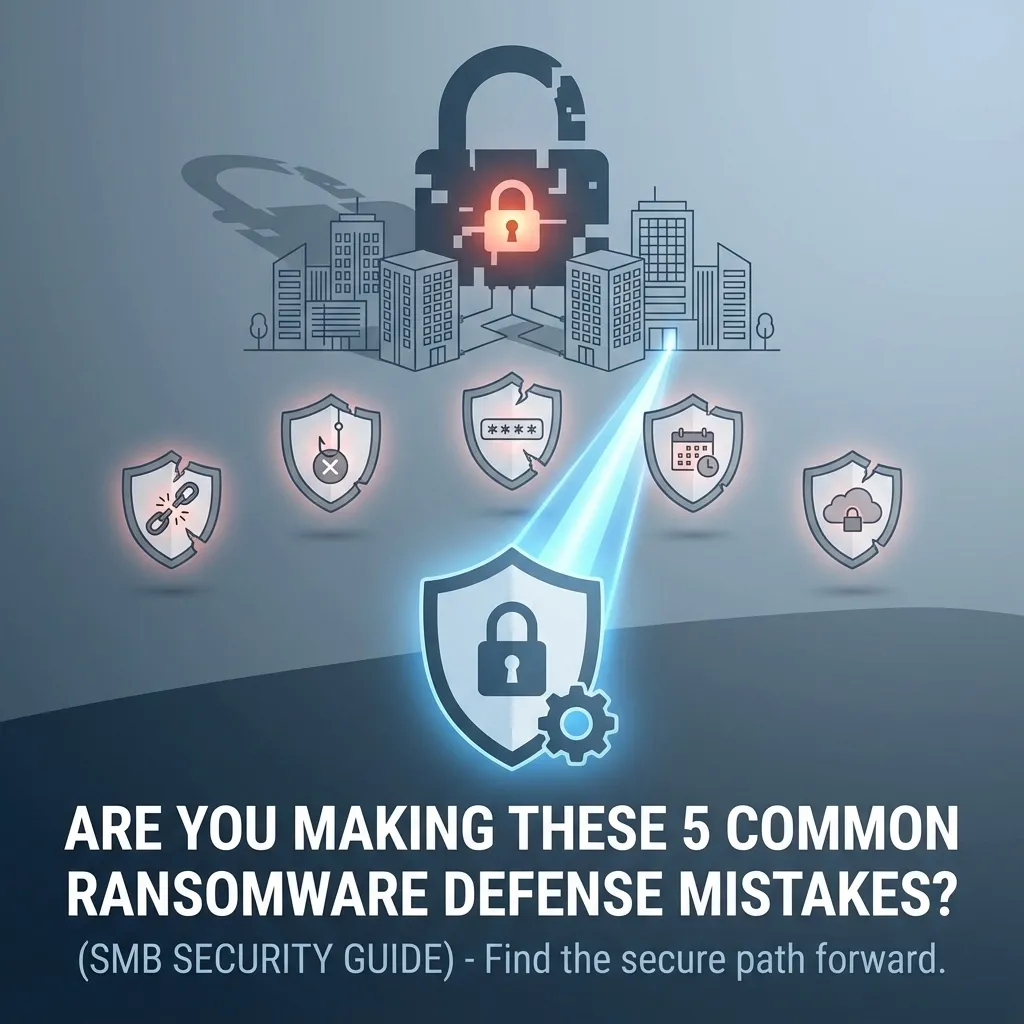
Most of these attacks succeed because businesses make the same five preventable mistakes, over and over. Are you making them too?
Mistake #1: “We’re Too Small to Be a Target”
This might be the most dangerous misconception in cybersecurity. Picture a burglar choosing between a house with cameras and an alarm system, or one with an unlocked door. Cybercriminals think the same way — small businesses often hold valuable data (customer records, financial information, employee details) but maintain weaker defenses than large corporations. Attackers don’t discriminate by company size; they discriminate by security strength. A coffee shop with customer credit card data can be just as profitable a target as a Fortune 500 company, if it’s easier to breach.
The fix: Treat your business like the target it actually is. Enterprise-grade security, scaled appropriately to your size and budget, closes the gap that makes small businesses the “easy” choice.
Mistake #2: Treating Passwords as Your Only Lock
Even strong passwords aren’t enough on their own — stolen credentials get sold on the dark web constantly, and when employees reuse a password across personal and work accounts, one unrelated breach can hand attackers the keys to your entire business.
The fix: Multi-factor authentication requires a second form of verification beyond the password — usually your phone or an authentication app — across every critical system, not just email. Even if a password is stolen, it isn’t enough on its own to get in.
Mistake #3: Playing “Update Roulette” With Your Software
“I’ll update it later” is one of the most common — and most exploited — habits in IT. The majority of successful cyberattacks exploit known vulnerabilities that already have available patches. Cybercriminals run automated tools that scan the internet specifically for unpatched systems.
The fix: Automated, managed patch management applies updates during off-hours, tested before deployment, so you’re never choosing between security and productivity.
Mistake #4: Backing Up Like It’s 2005
When did you last actually test your backups? Having backups and having working backups are two different things — many businesses discover their backup solution failed only when they desperately need it. Worse, ransomware attacks increasingly target backup systems first, on the theory that a business with no recovery option is more likely to pay the ransom.
The fix: Follow the 3-2-1 rule — at least 3 copies of your data, on 2 different types of media, with 1 copy completely offline and air-gapped from your network — and test those backups regularly, not just when you remember to.
Mistake #5: Assuming Your Team Knows What They Don’t Know
Your employees are your first and last line of defense, but modern phishing doesn’t look like an obviously fake email anymore. Today’s attacks use AI to craft convincing messages that fool even tech-savvy people — imagine an email that appears to come from your CEO, with a matching writing style and a plausible urgent wire transfer request. Without training, how would your team know it’s a business email compromise attempt?
The fix: Ongoing security awareness training with real-world phishing simulations, immediate feedback, and content that actually sticks — not a once-a-year checkbox presentation.
Beyond the Big Five: Layered Defense
Fixing these five gaps is the foundation, but strong security still requires a layered approach — the same way you wouldn’t protect your home with just a front door lock. A few additions worth having in place:
- Network monitoring and managed detection & response — early detection turns a small breach into a non-event instead of a business-ending disaster.
- Modern endpoint protection — today’s tools use AI and behavioral analysis to stop attacks in real time, even ones that have never been seen before, unlike traditional signature-based antivirus.
- Incident response planning — when (not if) a security incident happens, a predetermined response plan is the difference between a minor disruption and a major one.
The Bottom Line
The average cost of ransomware recovery for small businesses exceeds $200,000, not counting lost business, reputational damage, and regulatory fines — compare that to the cost of implementing proper security measures upfront. You don’t have to become a cybersecurity expert yourself; you just need a partner who implements and manages these defenses for you.
CelereTech specializes in making enterprise-grade security accessible and affordable for small and medium businesses, addressing all five of these common mistakes and more. Don’t wait for a ransomware attack to find out which mistakes your business is making — contact CelereTech today for a free security assessment.